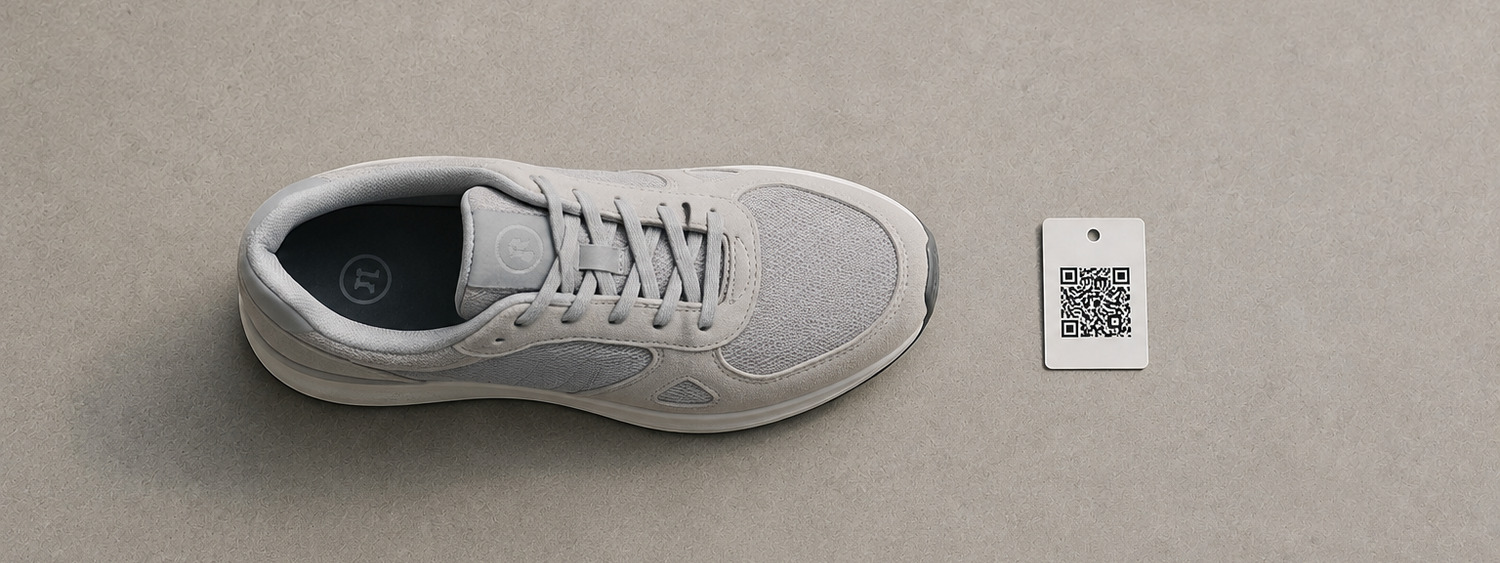

We have written a lot at Transpareo about the details and foundations of digital product passports: how information can be disclosed without losing the signature, why the AAS can be the foundation of the digital product passport, which comments we submitted on the UN Transparency Protocol, and why three lines become twenty under EN 18223. With our verification page, anyone can check a passport for themselves. What we never explained is what a DPP really is and what it is meant to be. This article does that.
A digital product passport (DPP) is a set of data about a product, opened by a QR code or another data carrier on the product. It describes what the product is made of, where it comes from, and how it can be repaired and recovered at the end of its life. For a growing number of products sold in the EU it is required by law. The legal basis is the EU’s Ecodesign Regulation; for batteries, the Batteries Regulation sets the first fixed deadline, 18 February 2027.
Three examples make it concrete. Scan the code on an e-bike battery and you see its capacity, its cell chemistry, the share of recycled raw materials and how to return it. A repair shop finds the spare part numbers and the removal instructions behind the same code. A market surveillance authority receives the test reports that show the battery complies with the rules. One code, three readers, and each sees what is meant for them.
Transpareo is a platform on which companies create, translate and publish these passports themselves. The Transpareo Time Machine shows a finished passport on a real example, with no sign-in. The Transpareo Time Machine is our open-source app for reading product passports, and it reads any passport that follows the standards, including ones hosted elsewhere.
How a product passport is built
Technically, a passport has two parts: a web address that belongs to exactly one product, and a structured set of data that the address serves. Structured means that every piece of information sits in a defined field with a defined meaning. A person reads the passport on a phone. Software reads the same information by machine, for instance a recycler’s sorting line that handles thousands of batteries a day.
A passport belongs to a model, a batch or a single item. The law for each product group decides which level applies. Batteries for electric vehicles need one passport per battery, because the condition and use of each one differ. For many consumer goods, one per model is expected to be enough.
Three properties make it a passport:
- It is regulated. The legal act for each product group sets its fields, and the meaning of every field is defined.
- It is tiered. The public sees one part, repairers and recyclers with a legitimate interest see more, and authorities see what they need for their checks.
- It lasts. The passport has to stay reachable for the required period, even if the manufacturer leaves the market or becomes insolvent.
The purpose is written into the regulation itself. Products should last longer and be easier to repair and recover, and anyone who wants to judge that needs reliable information. The passport puts that information on the product, for buyers, repairers, recyclers, retailers and authorities.
Behind a single code, every reader of a product gets the information meant for them.
Who needs one
The obligation falls on the company that places a product on the EU market, meaning it makes the product available in the EU for the first time. Usually that is the manufacturer. If the manufacturer is based outside the EU, the importer is responsible for making sure the passport exists and is correct. Retailers and online marketplaces make it accessible to their customers.
For companies outside the EU, this means that anyone supplying the EU needs the passport, wherever the product is made. A Swiss manufacturer selling to Germany is affected just as much as a factory in Asia supplying through an importer in Rotterdam. How far this reaches beyond the EU’s borders is the subject of our article on the Brussels effect.
The obligation attaches to placing a product on the EU market, wherever it was made.
The legal basis is Regulation (EU) 2024/1781, the Ecodesign for Sustainable Products Regulation, ESPR for short. It entered into force on 18 July 2024, and Articles 9 to 13 cover the product passport, its identifiers and the EU registry. On its own, it obliges no product at all. The obligation arises with a delegated act for a product group, which sets what the passport contains, who may see it and when it applies. At least 18 months pass between such an act entering into force and its application (Article 4(4)).
Some product groups carry the passport in their own legislation: batteries, construction products, detergents and toys. Excluded from the ESPR are, among others, food, feed, medicinal products, living plants and animals, and vehicles. A passport can still be useful there as voluntary information, as we describe for food and pharmaceuticals.
We have worked out who carries which role for 14 industries from the official texts, each with a timeline and sources, in the industry reference.
When it becomes mandatory
So far, only one product group has a fixed deadline: batteries. The other dates come from laws that set the passport for a later date, or from the Commission’s working plan, which gives an indicative year for each group.
- 20 July 2026, the EU registry runs. Implementing Regulation (EU) 2026/1778 has applied since 16 July 2026, and the registry has been in operation since 20 July 2026.
- 18 February 2027, batteries. Batteries for electric vehicles, for light means of transport such as e-bikes and e-scooters, and industrial batteries above 2 kWh need a passport as soon as they are placed on the EU market (Regulation (EU) 2023/1542, Article 77). What counts is the day the battery reaches the market. A battery built in 2026 and delivered in March 2027 needs one.
- Late 2026 to 2027, the first ESPR acts. The Commission’s working plan of 16 April 2025 puts iron and steel first, followed by aluminium, textiles and apparel, and tyres in 2027. With the 18-month period, the obligation applies to steel from 2028 at the earliest, and to textiles from 2029 at the earliest.
- Construction products. The Construction Products Regulation (EU) 2024/3110 provides for the passport. The date follows from its delegated act, which the Commission plans, indicatively, for 2027.
- Electronics, no date yet. The working plan assigns electronics to two horizontal acts: repairability, indicatively 2027, and recycled content and recyclability of electrical and electronic equipment, indicatively 2029.
- Furniture and mattresses follow in 2028 and 2029 under the working plan, each applying 18 months later at the earliest.
- 23 September 2029, detergents. The new Detergents Regulation introduces the passport for these products.
- 1 August 2030, toys. The new Toy Safety Regulation requires a passport for every toy on the EU market from this date.
The years in the working plan are the Commission’s planning and can move. We follow the legal acts as they take shape, and we submitted four comments to the Commission on the draft registry regulation.
What an adopted legal act says is binding; every other date is planning.
A late date is still a reason to start early. Most of the time goes into the information only your suppliers have, into the clauses you write into purchase contracts to get it, and into putting your master data in order. What this looks like for batteries is covered in ESPR timeline 2027.
What it contains
The legal act for each product group sets the exact content. Annex III of the ESPR provides the framework these acts draw on, and in practice the same topics come up again and again:
- Identity: the unique product identifier, model, batch or serial number, manufacturer and importer with their identifiers, and the place and date of manufacture.
- Composition: materials and substances of concern; for batteries, the cell chemistry and the shares of cobalt, lithium, nickel and lead, including recycled content.
- Environmental impact: the carbon footprint or other indicators where the legal act requires them, calculated by a prescribed method.
- Use and repair: instructions for use and safety, spare parts, disassembly instructions, and the expected lifetime.
- End of life: how the product is returned, taken apart and recovered.
- Evidence: the declaration of conformity, test reports and certificates.
The battery passport is the furthest along. Annex XIII of the Batteries Regulation sets the fields, and a Commission guide of 28 July 2026 classifies all 71 data points as mandatory, optional, only where applicable, or not yet to be shown at launch. The carbon footprint and the information on responsible sourcing of raw materials fall into the last group, because the legal acts defining their format are still missing. Which data actually has to be filled in by February 2027 is set out in our article on the battery passport’s required data.
Not every piece of information is meant for every reader. In the battery passport, the public sees a model’s basic data: composition, capacity, and notes on use, safety and recycling. People with a legitimate interest, such as a repair shop or a recycler, also see the detailed composition, spare part numbers, disassembly information and the state of the individual battery. Authorities, notified bodies and the Commission receive the test reports.
The legal act decides which information belongs in which tier; the platform has to enforce it. In Transpareo, visibility is a property of each individual field. A protected tier carries its own signature too and can be verified on its own, as our article on selective disclosure shows.
The law decides who may see what, and every tier can be verified on its own.
How the passport reaches the reader
Three things make up the path from product to passport: a data carrier on the product, a unique identifier and an address where the passport lives.
The data carrier is a QR code in most cases. A product group’s legal act can also allow other carriers, such as a radio chip, and it decides whether the carrier sits on the product, on the packaging or in the accompanying documents. For batteries, Article 77 requires a printed or engraved code that stays readable over the expected lifetime.
The identifier makes the product unique. The harmonised standards EN 18219 on identifiers and EN 18220 on data carriers are cited in Implementing Decision (EU) 2026/1736 and so carry the presumption of conformity. They allow several identifier schemes. The most widespread is GS1 Digital Link: the number already in the barcode becomes part of a web address, with batch and serial number added where needed. If you have no such number, our article on products without a GTIN covers the alternatives.
The address decides how long the printed code keeps working. If it sits on your own domain, it points today to the platform that serves the passport and later to another one, without reprinting a single label. Transpareo issues the address on your domain, together with the QR code. Why we chose this standard is explained in our article on GS1 Digital Link.
If the address sits on your own domain, the printed code keeps working after a change of platform.
Further harmonised standards cover data exchange, storage, interfaces and the data model (EN 18216, EN 18221, EN 18222 and EN 18223). We checked our platform against these standards clause by clause while they were still drafts, and wrote up how we implement each of them in Standard by Standard.
The EU registry completes this path. It keeps a directory of which passports exist, where they are and with which fingerprint; the product data itself stays with you. Only the company that places the product on the market may register it (ESPR Article 13(4) and (5), for batteries Article 77(10) of the Batteries Regulation). A service provider cannot currently do this on your behalf, and the Commission has announced the interface through which companies register their passports but has not yet specified it. Transpareo keeps ready what the entry asks for: product identifier, operator identifier, the passport’s address and its fingerprint. The details are in our analysis of the registry regulation.
How long it has to last
A printed code stays on the product for as long as the product is in use, ten years and more for many goods. The ESPR requires the passport to remain reachable for the period set in the legal act, even after insolvency, liquidation or the company’s withdrawal from the EU. The registry regulation keeps registration data for ten years unless the law for the product group sets a different period. For batteries, the passport ends when the battery is recycled (Article 77(8) of the Batteries Regulation).
This is the question we spend most time on, because a mistake here only shows years later, when nobody can put it right any more. So we built the passport to survive a cancellation, a change of provider and an insolvency:
- Every published version is signed and chained to the previous one. Any browser verifies it against a public key without contacting Transpareo. Our verification page shows this for any passport.
- The address sits on your domain, and after a cancellation the passport stays reachable at a permanent address.
- Once your passports are registered in the EU registry, every version is kept for ten years in an archive that cannot be altered afterwards.
- Your data belongs to you. You export the whole inventory as a spreadsheet, as a linked data set or through the programming interface.
This is more work to build than a product page with a PDF next to it. For information an authority is meant to rely on eight years from now, we think it is the right amount of work. How the signatures work and what they prove is explained in our article on signatures and certificates.
A product passport has to outlast the contract with the provider that serves it.
What it costs to run
The cost has three parts: the one-off setup, a platform’s running fee, and the recurring work on the data, meaning data quality, translation, life cycle assessments and certificates. Most people underestimate the third, because it comes back every year.
At Transpareo there is no setup fee, no consulting hours and no charge per scan. You pay a fixed monthly amount based on the number of published passports. You create as many products, components, images and documents as you need. Translation into 40 languages, including all 24 official EU languages, is included in the plan. The amounts in francs, euros and dollars are on the pricing page, and you can try it free before the first month, with no credit card.
What remains is your own work on the data. No provider can take that off your hands, and we would rather say so up front. It is more manageable than many expect, though, because a passport per model is created once and reused for the whole batch.
There is a second side to the calculation. Member states set the fine for a missing passport, and usually more expensive than the fine is the ban on placing the goods on the market: a shipment without a passport stays where it is until one has been supplied and checked. The comparison is set out in What the DPP obligation really costs.
A shipment held for a missing passport costs more than the passport.
How to get started
Four steps lead to the first published passport, and none of them depends on a legal act that is still missing.
- Take stock. Which information do you already have, spread across your ERP, spreadsheets and your suppliers’ data sheets? Usually much of it exists, only in many places. Our guide to digitising product data shows how to bring it together.
- Bring in your suppliers. Information such as recycled content or the origin of raw materials is known only to your suppliers. Set out in your purchase contracts which information they deliver and in what form.
- Start with a few models. Create a passport for five to ten real products. The gaps in the data model only show once you implement it.
- Check the provider. Our provider checklist lists the 30 questions worth asking before choosing a platform, and it applies to every provider, us included.
The data takes months and the legal act only sets a date, so start with the data.
For every industry with a passport obligation, the industry reference offers a checklist of the required data to download; for batteries, one each for vehicle, industrial, stationary storage, e-bike and portable batteries. If you would rather look straight away, the demo account is open without registration and shows a complete account from both sides.
Questions on this article
What is a digital product passport?
A structured set of data about a product, opened by a QR code or another data carrier on the product. It holds information on composition, origin, repair and recovery, tiered by reader: the public sees one part, repairers, recyclers and authorities see more. The legal basis is the Ecodesign Regulation (EU) 2024/1781, and for batteries the Batteries Regulation (EU) 2023/1542.
When is a product passport mandatory?
For batteries for electric vehicles, light means of transport and industrial batteries above 2 kWh, from 18 February 2027. Detergents follow on 23 September 2029, toys on 1 August 2030. For steel, textiles, tyres, furniture, construction products and electronics, the date follows from delegated acts the Commission plans for 2026 to 2029; the obligation starts at the earliest 18 months after an act enters into force.
Which products need a passport?
Every physical product for which a delegated act under the ESPR or its own legislation provides for one. Today that means batteries, and in the coming years steel, aluminium, textiles, tyres, furniture, mattresses, construction products, detergents, toys and electronics. Excluded from the ESPR are, among others, food, feed, medicinal products and vehicles.
Does the manufacturer or the importer create the passport?
The company that places the product on the EU market is responsible. If the manufacturer is in the EU, that is the manufacturer; if a manufacturer supplies from outside, the importer has to make sure the passport exists and is correct. In practice the manufacturer supplies the data, and who owes what belongs in the supply contract.
Do I need a GTIN?
No. What is required is a unique identifier under a recognised scheme. With a GTIN it becomes a GS1 Digital Link that other systems can read as well; without a GTIN, other recognised routes exist. In Transpareo every passport carries a unique identifier, and the QR code leads to it the same way in both cases.
Do I have to register the passport in the EU registry?
Yes, once the legal act for your product group applies, and you register it yourself; a service provider may not currently do it for you. The interface for this has been announced but not yet specified. Transpareo keeps everything the entry asks for ready, so the entry stays short.
How long does the passport have to stay available?
For as long as the legal act for the product group sets, and also after insolvency or the company’s withdrawal from the EU. The registry keeps registration data for ten years unless the law for the product group provides otherwise. The battery passport ends when the battery is recycled.
Does it have to be a QR code?
The QR code is the most common data carrier, and for batteries it is required. Other product groups may allow a radio chip or another carrier under their legal act. What matters is the address behind the code: if it sits on your own domain, the printed code keeps working after a change of platform.
How much does a product passport cost?
At Transpareo, a fixed monthly amount based on the number of published passports, with no setup fee and no charge per scan; the amounts are on the pricing page. On top comes your own work on the data, which arises with every provider.
What is the difference between a DPP and the battery passport?
The battery passport is the first product passport to become mandatory. It follows the Batteries Regulation, which has its own fields and deadlines, and it is held in the same EU registry as the passports under the ESPR. What you build for the battery passport carries over to the passports of further product groups.
Does it apply to companies in Switzerland?
Yes, for every product supplied to the EU. The obligation attaches to placing the product on the EU market and applies wherever the company is based or manufactures, in Switzerland as in Asia.
Can I wait until all the rules are settled?
The fields for batteries are settled, and for the other groups they are taking shape in the drafts and in the ESPR’s framework. What takes months is the data from suppliers and the contracts for it. If you start now, your data is in order when the legal act arrives, and you only add the fields that are new.


