

A T-shirt in a German clothes shop has passed through four businesses before it hangs there. A garment factory in Gazipur, north of Dhaka, sewed it. A knitting mill with its own dye house supplied the fabric, a spinning mill further inland the yarn, a trader the cotton.
The Digital Product Passport that clothing sold in the EU is expected to carry from 2029 asks about every one of those steps: where the cotton came from, which dyes are in the fabric, which sites the shirt was made in. The fashion brand has to issue it, and of the four businesses it knows one: the garment factory it placed the order with.
The answers sit at the far end of the chain
The spinning mill has no computer. It has the mill manager’s phone. According to the latest household survey of the Bangladesh Bureau of Statistics, 72 per cent of households own a smartphone and 9 per cent a computer. So the question about the cotton has to reach that phone, in Bengali, with no account, password or training, and the answer has to travel back through three businesses before it appears in the brand’s passport.
For batteries, what the passport requires is already settled: for the batteries of e-bikes and e-scooters, the European Commission’s guidance lists 54 mandatory data points from 18 February 2027, and here too most of them sit far down the chain, with cell and material makers.
Once the data is at hand, Transpareo publishes the passports in a few minutes: you import a spreadsheet, create the passports from it and publish them. The real work is gathering the data, and it pays to start on it well before the deadline.
We built supplier requests for exactly this laborious part, and you can now ask your suppliers for the data directly from Transpareo. You pick the fields a supplier should fill in. They open a link on their phone, answer what they know and pass the rest on to their own supplier. Every answer is reviewed at every tier before it moves on, and it reaches you in your language, with the original beside it.
This article walks through how that works, step by step, and the decisions behind it.
One request, one link
For the T-shirt you enter your garment factory as a supplier and tick what you want to know from it, such as the fibre composition, the weight, the origin of the cotton and the production sites. Whatever the passport still lacks is ticked already, and often that completes the selection. Then you set when you expect the answer.
The garment factory receives a link by email, from your workspace’s address. Before the deadline Transpareo reminds it, and if the link stays unopened, you hear about it. The link can also be pasted into any messaging app or read out over the phone, because its code leaves out characters that are easily mistaken, such as zero and O.
What the supplier sees
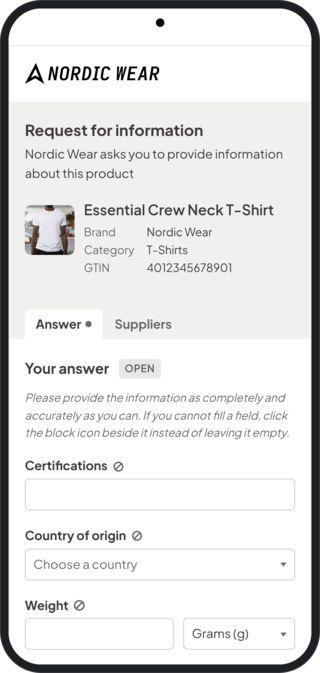
The garment factory opens the link on a phone and sees a page in your logo and your colours. It says who is asking and which product this is about, and below that your questions, only those. No account, no app and no training are needed.
Each question comes in the form that suits it. A country is picked from a list, a weight is entered with its unit, a photo goes up straight from the phone. If the phone rings in the middle of the form or the connection drops, nothing is lost.
We took the screenshot in our demo account, and the request is open to you there: open the sample request with the PIN 123456 and answer as the supplier. The account resets every hour, and your answer goes with it.
Three layers of protection
A link is easily forwarded and can end up in the wrong hands along the way. So it is protected on three levels.
The first is a PIN. The supplier chooses it on first opening the link, and the PIN appears in no email, and you never see it either. If the very first opening should be protected as well, let Transpareo generate a PIN and pass it on through a second channel, by phone for instance. Anyone guessing at a PIN gets only a few attempts before the link locks for a while, and you are told about it. If a supplier forgets their PIN, you generate a new one for them, and nothing else about their request changes.
The second is sharing as little as possible. Before the PIN, the page shows nothing of the product; after it, only which product this is about and your questions. It shows the values your record already holds only if you choose to. Anyone who gets hold of a link and its PIN learns only what you are asking about which product.
The third is an account of their own. If you work closely with a supplier, you invite its staff into the application manager. There they sign in with an account of their own and, if you wish, a second factor such as an authenticator app or a security key. They see exactly the products and components that supplier delivers to you and answer your requests without a PIN. If you wish, they maintain those products themselves as well.
Pre-filled or blank
Whether the supplier sees what your record already holds is your choice on every request. Unless you choose otherwise, every field starts blank, and they see only your questions. We chose that on purpose: what your record holds may be confidential, and it should reach a supplier only when you decide it should.
If your existing data should help them, send it along. If the fibre composition is already there, they confirm it or adjust a share and type nothing again.
When the supplier has to ask in turn
The garment factory knows the weight, the sizes and the seams. Where the cotton came from, it does not know. So it asks its knitting mill, right from its own page: it picks the questions the mill should answer and gets a link of its own for them, with its own PIN. It sends that link the way it always does, by email, messaging app or phone. Transpareo needs no access to its mailbox for this.
The knitting mill asks the spinning mill, the spinning mill asks its cotton trader, and the trader can ask further in turn. A request reaches as far down the supply chain as it needs to. If you withdraw your request, every request below it closes at the same moment.
Your brand appears where you hold the business relationship: your direct supplier sees a page in your logo and your colours. Further down, every supplier asks in its own name, and whoever passes a request on decides for themselves how much of their customer they show. Your name and logo do not appear on their page; only the link’s address names the workspace the request runs through. The supplier can also hide the brand and the product and add a few words of its own on what it needs and why.
We care about the business interests of everyone involved. The spinning mill gets its question from the customer it sells its yarn to, in that customer’s words and with its reasons, and no request from a European fashion brand it has never heard of. What a company discloses is its own decision, and the questions travel as a conversation between partners who talk to each other anyway. Every request stays a matter between two companies that know each other.
Likewise, you do not see whom your supplier asked. Beside its request you see only how many requests it passed on. Names, addresses and the answers from the tiers below stay with it, and whatever it takes from those answers reaches you under its own name. A brand wants to know its supply chain, and a supplier wants to protect its business: its sources, its prices and its place between you and its own supplier. Transpareo lets it do so, because a supplier would not use a tool that exposed it.
Each tier reviews the tier below
The spinning mill’s answer goes to whoever asked it, the knitting mill. The knitting mill sees every value, accepts it or sends it back with a remark. What it accepts it combines with its own data on the fabric and the dyeing, corrects if needed, and sends its whole answer on under its own name. So it goes, tier by tier, until your direct supplier’s answer reaches you.
Everyone reviews only what comes from companies they asked themselves.
So each tier puts its name to what it passes on, and you receive a single, coherent answer.
For the tiers in between this means a little more work. We still think the rule is right, because it mirrors how supply relationships work: everyone vouches for the companies they hold contracts with.
Your decision, field by field
Each answer arrives as a proposal for everyone who may edit the product, and you go through it field by field. You accept each value as it came, correct it in your own words while the supplier’s version is kept, or send it back with a short reason. The supplier finds your remark beside the field the next time they open the link and answers only what is still open.
An answer changes nothing on your record by itself.
Once everything is decided, it becomes a new version of your record, naming the supplier and you. Years later you can still look up which value came from whom, because every change to a product lands in its history. You can restore any earlier state from there, as a new entry, so the history stays complete. Photos appear on the product only once you have accepted them.
If someone changed the record while the supplier was still typing, Transpareo shows you those fields first, with the value from back then, the current one and the proposed one. No proposal silently overwrites what someone else has entered in the meantime.
Everyone in their own language
The spinning mill’s manager opens the link, and the page speaks Bengali, because their phone does and Bengali is one of your workspace’s languages. They answer in Bengali. Your buying team in Germany reads the answer in German, and whoever opens the published passport in France reads it in French. Nobody in that chain has to work in a foreign language.
As soon as an answer comes in, Transpareo translates its texts into the languages of your workspace. There are 40 to choose from, including all 24 official languages of the EU and, from the major textile countries, Bengali, Hindi, Vietnamese, Turkish and Indonesian. Codes, numbers, dates and countries stay as they are, because translating them would be wrong. We have described separately how the translation handles technical terms.
Whoever reviews, at whatever tier, reads the supplier’s text and, beneath it, the version in their own language. The original is stored beside every translation. For mandatory data that matters: the translation helps the reader, and what the supplier stated is the original.
What a request relies on
A request settles how the data reaches you. Whether a supplier hands it over is still a matter for your supply contract. For the textile industry we recommended obliging the garment factory by contract to pass on the data from the weaving and spinning mills. The request is the tool it does that with, reviewed and with a name attached at every tier.
Suppliers with their own company software you still connect directly. The request is built for everyone else.
What ends up in the passport
For the T-shirt this means: the origin of the cotton is in the passport, entered by whoever knows it, in their own language, and reviewed at every tier on its way to you. All it took on your side was one request sent and one answer reviewed.
To see what such a passport looks like, look at the T-shirt in our public demo account: every material with its country of origin, every published version with its signature, in 40 languages and with no sign-up.
The same account holds two requests about the T-shirt’s materials. The spinning mill has answered its request, and the cotton’s origin and certifications come from that answer. The request to the elastane’s yarn maker is still open. Open it with the PIN shown beside it and you see the page your supplier sees. Sending a request of your own works there too. The demo account sends no mail, so you copy the link.
Questions on this article
Does the supplier need an account or an app?
No. They need the link and a browser, on a phone or a computer. On first opening it they choose a PIN, and from then on the request opens only with it.
Who knows the PIN?
A PIN the supplier chooses is known only to them; it is not shown to you either. If you let Transpareo generate the PIN instead, you see it in the request and pass it on through a second channel. The email carrying the link never contains a PIN.
How many tiers deep does a request reach?
As deep as your supply chain goes. Every supplier can pass on what they were asked, and so can their supplier, with no limit on the number of tiers. If you withdraw your request, every request below it closes at the same moment.
Do I see which suppliers my supplier asked?
No. You see only how many requests it passed on. Whom it asked and what those companies answered stays with it; whatever it takes from those answers reaches you under its own name.
What happens if a supplier does not answer?
Before the deadline Transpareo reminds them twice by email. If no address is on file for them, the reminder comes to you to pass on. If the time is not enough, you extend the deadline.
Can a supplier send photos as well?
Yes, straight from the phone. The pictures stay under lock until you review the answer and appear on the product only once you accept them. Rejected pictures are deleted.