

A T-shirt in a German clothes shop has passed through four businesses before it hangs there. A garment factory in Gazipur, north of Dhaka, sewed it. A knitting mill with its own dye house supplied the fabric, a spinning mill further inland the yarn, a trader the cotton.
The Digital Product Passport that clothing sold in the EU is expected to carry from 2029 asks about every one of those steps: where the cotton came from, which dyes are in the fabric, which sites the shirt was made in. The fashion brand has to issue it, and under the EU’s Ecodesign Regulation (ESPR) its data has to be accurate, complete and up to date. Of the four businesses, the brand knows one: the garment factory it placed the order with, its tier 1 supplier. The knitting mill is tier 2, the spinning mill tier 3 and the trader tier 4.
The answers sit at the far end of the chain
The spinning mill has no computer. It has the mill manager’s phone. According to Bangladesh Bureau of Statistics figures for 2025, reported by The Business Standard, 72 per cent of households own a smartphone and 9 per cent a computer. So the question about the cotton has to reach that phone, in Bengali, with no account, password or training, and the answer has to travel back through three businesses before it appears in the brand’s passport.
For the batteries of e-bikes and e-scooters, the European Commission’s guidance lists 50 mandatory data points from 18 February 2027, and most of them sit just as far down the chain, with cell and material makers.
Once the data is at hand, Transpareo publishes the passports in a few minutes: you import a spreadsheet, create the passports from it and publish them. The real work is gathering the data, and it pays to start on it well before the deadline.
How Transpareo Upstream works
We built Transpareo Upstream for exactly this laborious part. You ask your suppliers straight from your workspace, in six steps:
- You pick the fields a supplier should fill in, and it gets a link.
- Your supplier answers on its phone and passes what it does not know to its own supplier, which can do the same.
- Each tier checks every answer from the tier below: it accepts a value, corrects it or sends it back with a remark.
- What a tier accepts, it passes on under its own name, and with that it takes responsibility for it.
- You review your direct supplier’s answer the same way, field by field, in your language.
- Only what you accept or correct enters your record.
How you ask a supplier for passport data
For the T-shirt you enter your garment factory as a supplier and tick what you want to know from it, such as the fibre composition, the weight, the origin of the cotton and the production sites. Whatever the passport still lacks is ticked already, and often that completes the selection. Then you set when you expect the answer.
The garment factory receives a link by email, from your workspace’s address. The link can also be pasted into any messaging app or read out over the phone, because its code leaves out characters that are easily mistaken, such as zero and O.
What the supplier sees
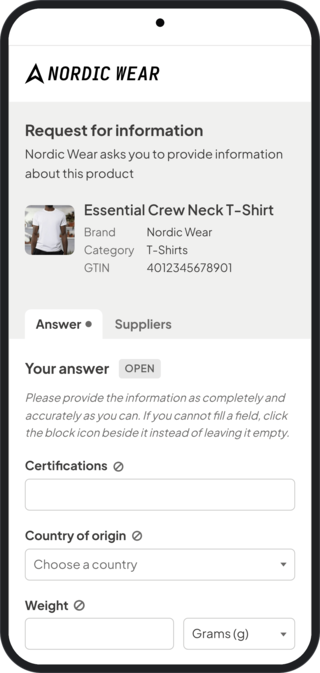
The garment factory opens the link on a phone and sees a page in your logo and your colours. It says who is asking and which product this is about, and below that your questions, only those. No account, no app and no training are needed.
Each question comes in the form that suits it. A country is picked from a list, a weight is entered with its unit, a photo goes up straight from the phone. If the phone rings in the middle of the form or the connection drops, nothing is lost.
Try it yourself now: open the sample request to a supplier with the PIN 123456 and answer as the supplier. It sits in our public demo account, open with no sign-up, which besides the request also shows the T-shirt’s passport with every material and its country of origin. The account resets every hour.
Three layers of protection
A link is easily forwarded, so it is protected on three levels.
The first is a PIN. The supplier chooses it on first opening the link; it appears in no email, and you never see it. To protect the very first opening as well, let Transpareo generate the PIN and pass it on through a second channel, by phone for instance. After a few wrong guesses the link locks for a while, and you are told. A supplier who forgets the PIN gets a new one from you, and nothing else about the request changes.
The second is sharing as little as possible. Before the PIN the page shows nothing of the product, and after it only which product this is about and your questions. Whoever gets hold of a link and its PIN learns no more than that.
The third is an account of their own: staff you invite from a supplier you work closely with sign in to the application manager, with a second factor if you wish, and answer your requests there without a PIN.
Pre-filled or blank
Whether the supplier sees what your record already holds is your choice on every request. Unless you choose otherwise, every field starts blank, and they see only your questions. We chose that on purpose: what your record holds may be confidential, and it should reach a supplier only when you decide it should.
If your existing data should help them, send it along. If the fibre composition is already there, they confirm it or adjust a share and type nothing again.
When the answer sits at tier 2 or tier 3
The garment factory knows the weight, the sizes and the seams. Where the cotton came from, it does not know. So it asks its knitting mill, right from its own page: it picks the questions the mill should answer and gets a link of its own for them, with its own PIN. It sends that link the way it always does, by email, messaging app or phone. Transpareo needs no access to its mailbox for this.
The knitting mill asks the spinning mill, the spinning mill asks its cotton trader, and the trader can ask further in turn. A request reaches as far down the supply chain as it needs to. If you withdraw your request, every request below it closes at the same moment.
Your brand appears where you hold the business relationship: your direct supplier sees a page in your logo and your colours. Further down, every supplier asks in its own name and decides how much of its customer it shows. By default the request it passes on keeps your logo, your workspace’s website and the record; with Hide brand and record details switched on, it opens at a neutral Transpareo address with Transpareo’s logo and shows neither your name nor the product. Beside your request you see only how many requests were passed on from it, counted across every tier, and never whom your supplier asked, because a supplier passes your questions on when its sources stay with it.
Each tier reviews the tier below
The spinning mill’s answer goes to whoever asked it, the knitting mill. The knitting mill sees every value, accepts it or sends it back with a remark. What it accepts it combines with its own data on the fabric and the dyeing, corrects if needed, and sends its whole answer on under its own name. So it goes, tier by tier, until your direct supplier’s answer reaches you.
Everyone reviews only what comes from companies they asked themselves.
So you receive a single, coherent answer.
Your decision, field by field
Each answer arrives as a proposal for everyone who may edit the product, and you go through it field by field. You accept each value as it came, correct it in your own words while the supplier’s version is kept, or send it back with a short reason. The supplier finds your remark beside the field the next time they open the link and answers only what is still open.
An answer changes nothing on your record by itself.
Once everything is decided, it becomes a new version of your record, naming the supplier and you. Years later you can still look up which value came from whom, because every change to a product lands in its history. Photos appear on the product only once you have accepted them.
If someone changed the record while the supplier was still typing, Transpareo shows you those fields first, with the value from back then, the current one and the proposed one. No proposal silently overwrites what someone else has entered in the meantime.
Everyone in their own language
The spinning mill’s manager opens the link, and the page speaks Bengali, because their phone does and Bengali is one of your workspace’s languages. They answer in Bengali. Your buying team in Germany reads the answer in German, and whoever opens the published passport in France reads it in French.
As soon as an answer comes in, Transpareo translates its texts into the languages of your workspace. There are 40 to choose from, the official languages of the EU among them. Codes, numbers, dates and countries stay as they are. We have described separately how the translation handles technical terms.
Whoever reviews, at whatever tier, reads the supplier’s text and, beneath it, the version in their own language. The original is stored beside every translation. For mandatory data that matters: the translation helps the reader, and what the supplier stated is the original.
Why it pays to start today
For the T-shirt this means: the origin of the cotton is in the passport, entered by whoever knows it, in their own language, and reviewed at every tier on its way to you. Transpareo Upstream makes answering easier and faster for every supplier. Gathering everything a passport needs still takes time, because each tier first collects its own data and, where it has to, asks its own supplier.
That time is well spent, because a passport offers more than compliance. In the shop it answers questions about material, origin and care before anyone buys, and after the purchase it remains a channel to your customers that you can update at any time. That makes it a marketing tool right on the product. So it pays to start today: whatever you accept from your suppliers’ answers now reaches your customers as soon as you publish the passport.
Questions on this article
Does the supplier need an account or an app?
No. They need the link and a browser, on a phone or a computer. On first opening it they choose a PIN, and from then on the request opens only with it. That PIN is known only to them, and you do not see it either. If you let Transpareo generate the PIN instead, you see it in the request and pass it on through a second channel; the email carrying the link never contains a PIN.
How do I get passport data from tier 2 and tier 3 suppliers?
You ask your direct supplier. In Transpareo Upstream it passes the questions it cannot answer to its own supplier, with a link and a PIN of their own, and that supplier can pass them on again. Every tier reviews the answers from the tier below before it sends its own answer on, so the values from tier 2 and tier 3 reach you reviewed and under your direct supplier’s name.
How many tiers deep does a request reach?
As deep as your supply chain goes. In Transpareo Upstream every supplier can pass on what they were asked, and so can their supplier, with no limit on the number of tiers. If you withdraw your request, every request below it closes at the same moment.
Do I see which suppliers my supplier asked?
No. You see only how many requests were passed on below yours, counted across every tier. Whom it asked and what those companies answered stays with it; whatever it takes from those answers reaches you under its own name.
What happens if a supplier does not answer?
Before the deadline Transpareo reminds them twice by email. If no address is on file for them, the reminder comes to you to pass on. If the time is not enough, you extend the deadline.
Can a supplier send photos as well?
Yes, straight from the phone. The pictures stay under lock until you review the answer and appear on the product only once you accept them. Rejected pictures are deleted.